The 2018 International Building Code, as adopted by Arkansas, mandates deep foundation investigations when site-specific geotechnical data indicates shallow systems cannot meet performance requirements—a scenario frequently encountered throughout Fayetteville. The city’s position atop the Springfield Plateau exposes construction to the Mississippian-age Boone Formation, a limestone unit riddled with solution cavities, pinnacles, and highly irregular bedrock topography. Test pits provide initial subsurface reconnaissance across these karst features, helping our engineering team map the soil-rock interface before committing to a deep foundation layout. Designing pile foundations here requires integrating ASCE 7-22 load combinations with local geologic wisdom: a cavity roof can collapse under service loads if the pile tip is not socketed sufficiently into competent rock. The design process addresses axial capacity, lateral response, settlement tolerance, and down-drag forces that arise when clay-rich residuum consolidates around the shaft. For any structure exceeding two stories in Fayetteville, a properly executed pile foundation design transforms subsurface uncertainty into a quantifiable, insurable load path that protects the investment through decades of seasonal moisture cycling and occasional seismic tremor.
In Fayetteville’s karst, a pile tip socketed into a limestone pinnacle with an unseen cavity three feet below is not a foundation—it is a pending structural failure waiting for the next heavy rain.
Scope of work in Fayetteville Arkansas
- Drilled shafts ranging from 24 to 60 inches diameter, socketed minimum 5 feet into unweathered limestone
- Driven H-piles with Delmag D19-42 diesel hammers achieving refusal criteria on chert-hardened bedrock
- Osterberg cell testing for high-capacity piles exceeding 400 kips design load
- Cross-hole sonic logging tubes cast into each shaft for integrity verification
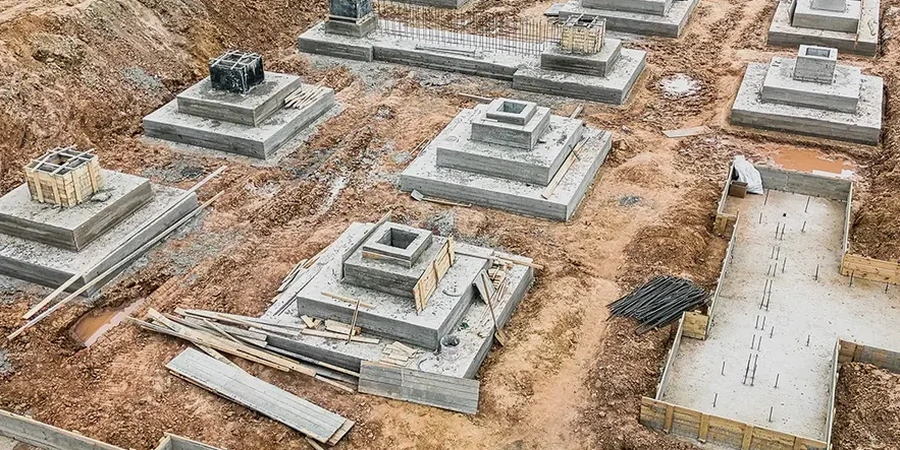
Critical ground factors in Fayetteville Arkansas
Northwest Arkansas sits within the New Madrid Seismic Zone’s area of influence, and while Fayetteville’s peak ground acceleration values from USGS hazard maps are moderate, the karstic subsurface amplifies risk in ways that uniform hazard spectra cannot capture. A 2010 sinkhole collapse near the University of Arkansas campus swallowed a portion of a parking lot overnight, underscoring how quickly the Boone Formation’s cavities can propagate to the surface when groundwater levels fluctuate. For pile-supported structures, the primary failure mechanism is not the pile itself but the bearing stratum: designing a pile tip that relies on a thin roof of limestone over a void creates a brittle collapse scenario with zero warning. Our design methodology incorporates rock coring at each pile location and cross-hole sonic logging to verify integrity, ensuring every deep foundation element terminates in a verified competent socket. The slope stability analysis becomes equally critical on Fayetteville’s hillside lots, where pile groups must resist lateral spreading of colluvial soils during heavy spring rainfall events that saturate the upper 15 feet of the profile.
Our services
Every pile foundation design we deliver for Fayetteville projects begins with a karst-specific subsurface investigation and ends with a stamped, construction-ready package that contractors can bid with confidence. The following engineering services form the core of our deep foundation practice in Northwest Arkansas.
Axial and Lateral Pile Capacity Design
We compute ultimate and allowable capacities using FHWA drilled shaft methods for rock sockets and Nordlund/Thurman methods for driven piles, factoring in the Boone Formation’s variable RQD values. Lateral response is modeled with COM624P or LPILE, accounting for the stiff residual clays that dominate Fayetteville’s upper 10 to 20 feet and can impose significant passive wedge forces on pile groups.
Pile Load Testing and Integrity Verification
Our team specifies and oversees static load tests per ASTM D1143, high-strain dynamic testing per ASTM D4945, and cross-hole sonic logging per ASTM D6760. For critical structures in Fayetteville’s karst zones, we recommend Osterberg cell testing to isolate end bearing and skin friction components, confirming that the rock socket capacity assumed in design actually exists at each production pile location.
Common questions
What is the typical cost range for a pile foundation design package for a commercial building in Fayetteville?
For a mid-size commercial structure in Fayetteville requiring a complete pile foundation design—including geotechnical investigation, rock coring at pile locations, axial and lateral capacity calculations, and construction-ready drawings—the engineering fee typically ranges from US$1,520 to US$6,330. The final cost depends on the number of piles, the complexity of the karst subsurface, the required load testing program, and whether Osterberg cell or static load testing is specified.
How do you address the risk of limestone cavities beneath pile tips in Fayetteville?
The Boone Formation beneath Fayetteville contains solution cavities that can go undetected with standard borings alone. Our protocol requires rock coring at every pile location to minimum depths of 10 feet below the anticipated tip elevation, supplemented by cross-hole sonic logging or parallel seismic testing. If a cavity is detected, we either deepen the socket to bypass it or pressure-grout the void before pile construction. This approach follows FHWA-NHI-16-010 recommendations for karstic foundations and has been validated on multiple University of Arkansas area projects.
What pile types are most suitable for Fayetteville’s soil and rock conditions?
Drilled shafts socketed into the Boone Formation limestone are the most common choice for Fayetteville projects due to their ability to penetrate chert bands and achieve positive rock socket contact. Driven H-piles work well on sites with thinner overburden and shallow bedrock, while micropiles are specified for restricted-access sites or underpinning applications in downtown Fayetteville where existing structures cannot tolerate vibration. Helical piles serve lighter structures on expansive clay sites where the water table fluctuates seasonally, but they are not recommended for karstic bedrock unless a rock socket is achievable.