The Arkansas Department of Transportation specifies ASTM D1883 and AASHTO T-193 for all pavement design projects in Washington County, which makes laboratory CBR testing a non-negotiable first step before any road, parking lot, or runway construction begins. Fayetteville sits on the Springfield Plateau, where the residual soils derived from weathered limestone and shale create highly variable subgrade conditions that can swing from stable to problematic within the span of a single project site. Our laboratory CBR test provides the empirical data engineers need to calibrate pavement thickness, select appropriate base course materials, and avoid the costly overruns that come from designing on assumed rather than measured soil strength. In a region that experiences freeze-thaw cycles and seasonal moisture fluctuations, understanding how your subgrade behaves under saturated conditions is particularly critical for long-term pavement performance.
A soaked CBR value below 3 percent in Fayetteville's residual clay means you are not designing a pavement — you are designing a future liability.
Scope of work in Fayetteville Arkansas
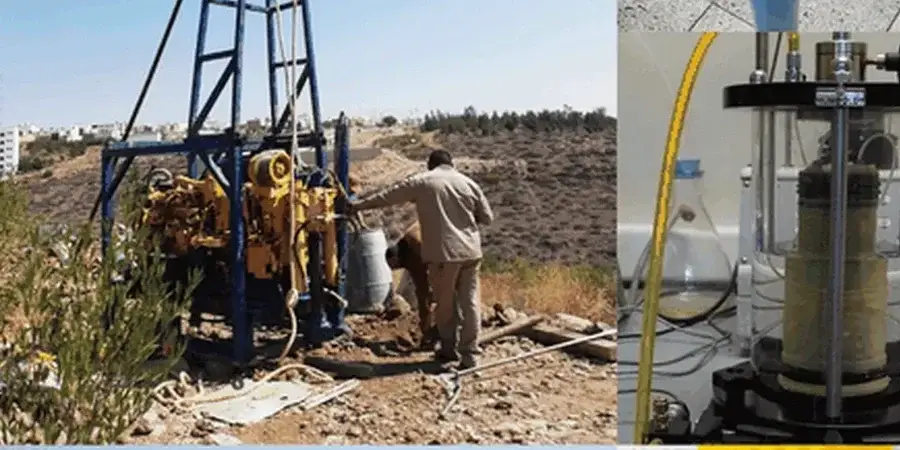
Critical ground factors in Fayetteville Arkansas
The residual soils across Fayetteville, particularly the silty clays that mantle the Boone Formation limestone, are notorious for losing significant strength when saturated — a phenomenon that has led to premature pavement failures on several commercial developments along the Joyce Boulevard corridor. A project that skips laboratory CBR testing and relies on generic assumed values risks underdesigning the pavement section, which results in rutting, alligator cracking, and eventual base failure within the first five years of service. The financial exposure is substantial: reconstructing a failed parking lot or access road typically costs three to five times the original pavement installation, not counting business interruption and liability from damaged vehicles. Our laboratory CBR test eliminates this uncertainty by delivering a defensible design number that accounts for the worst-case moisture scenario. For sites where the native soil CBR falls below the 5 percent threshold, engineers can evaluate stabilization options or specify imported select fill with confidence, knowing the baseline condition has been properly documented per ASTM D1883 requirements.
Our services
Our laboratory CBR testing program in Fayetteville covers the full workflow from sample extrusion through final report, with all procedures conducted under our ISO 17025-accredited quality system to ensure defensible, repeatable results for ARDOT and municipal submittals.
Standard Soaked CBR Testing
Complete ASTM D1883 compliant testing with 96-hour soak, swell measurement, and penetration resistance at both 0.1-inch and 0.2-inch intervals. Includes moisture-density relationship determination using standard or modified Proctor compaction effort per project specifications.
Pavement Design Support Package
Integrated reporting that combines laboratory CBR values with soil classification data, Atterberg limits, and grain size distribution. Results are formatted for direct input into AASHTO pavement design software, with recommendations for subgrade treatment when CBR values fall below project thresholds.
Common questions
What is the typical turnaround time for a laboratory CBR test in Fayetteville?
A standard soaked CBR test following ASTM D1883 requires a minimum of four days for the saturation period alone, plus compaction and testing time. Typical report delivery is five to seven business days from sample receipt. For time-sensitive projects, we can coordinate expedited processing upon request, though the 96-hour soak cannot be shortened without compromising the validity of the result.
How much does a laboratory CBR test cost in Northwest Arkansas?
The standard soaked CBR test for a single point, including moisture-density relationship and full reporting, ranges from US$140 to US$240 depending on whether standard or modified Proctor compaction is specified and the number of points required. Multi-point projects benefit from volume pricing.
Do I need field CBR or laboratory CBR for my Fayetteville project?
Laboratory CBR is the preferred method for pavement design because it allows controlled moisture conditioning that simulates the worst-case saturated subgrade condition, which is essential in Fayetteville's climate. Field CBR can supplement the investigation for quality control during construction, but ARDOT and most geotechnical consultants base the pavement structural design on laboratory values per AASHTO T-193. More info.