Fayetteville sits at roughly 1,400 feet on the Springfield Plateau, where the residual cherty limestone weathering profile often hides pockets of soft alluvium and colluvium along the West Fork and Town Branch drainages. When a three-story mixed-use structure on Dickson Street showed 2.5 inches of predicted total settlement under static loads alone, the geotechnical review triggered a ground improvement alternative because over-excavation would have cost the developer six weeks of schedule and serious dewatering headaches. Stone column design became the practical path forward. We sized the columns at 30 inches diameter with a 1.5-meter triangular grid after confirming the undrained shear strength of the upper 12 feet remained above 15 kPa, which met the minimum threshold for vibro-replacement without excessive bulging. Before committing to the full array, we correlated the stratigraphy with CPT data from three soundings that mapped the soft zone continuity under the building footprint.
In Fayetteville's residual clays, we target a post-improvement equivalent friction angle of 38 degrees in the composite mass to limit differential settlement to half an inch in the column-to-untreated soil transition.
Scope of work in Fayetteville Arkansas
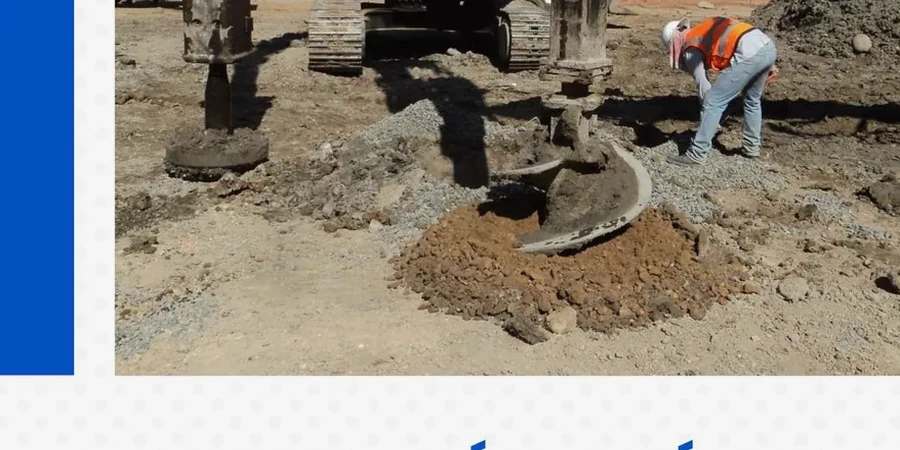
Critical ground factors in Fayetteville Arkansas
IBC Chapter 18 requires ground improvement design to be validated by a full-scale field test program when the improved area exceeds 2,000 square feet, and Fayetteville’s commercial parcels along College Avenue routinely trigger that threshold. The largest risk we track is a column punching failure through a thin crust into a liquefiable silt lens that the preliminary borings missed, which is why we run at least one SPT drilling log to 40 feet on every stone column project, not just the 20-foot minimum. In the 2024 USGS seismic hazard model, the Springfield Plateau bedrock amplifies short-period motion less than the Mississippi Embayment, but the soft soil pockets still generate a site class E or F profile that pushes the column design toward a lower area replacement ratio and tighter spacing to handle cyclic shear stress without excessive stone migration into the surrounding clay.
Our services
We deliver the full stone column design package from subsurface characterization through construction specifications, with every calculation backed by regional experience in the Boone Formation.
Stone Column Layout and Settlement Analysis
We develop the column grid, diameter, depth, and stone gradation using Priebe or Balaam-Booker methods, with 3D finite element verification when the column cap transfers load from a rigid mat.
QA/QC and Load Testing Program
We write the performance specification, witness the modulus test on the trial columns, and run zone load tests per ASTM D1143 to confirm the composite stiffness meets the design assumptions before production columns are installed.
Common questions
What soil conditions in Fayetteville require stone columns instead of shallow footings?
When the upper 15 to 20 feet of profile contain soft clays with an undrained shear strength below 30 kPa or loose silts with SPT N-values under 6, shallow footings produce settlement beyond the one-inch limit that most structural engineers specify. Stone columns bridge those weak layers by creating a composite mass that distributes the structural load deeper and reduces total settlement by 50 to 75 percent.
How long does a stone column design and testing program take?
The subsurface investigation with CPT or SPT takes one week in the field. Design calculations and the column layout report follow within ten working days. The field trial program with modulus and load testing adds another week, so a typical Fayetteville project moves from investigation to approved design in roughly four weeks.
What does stone column design cost for a typical Fayetteville commercial site?
The design package, including the supplemental borings, settlement analysis, column layout, and load test specification, ranges from US$1,320 to US$4,680 depending on the treated area and the number of trial columns required.
Do you verify the stone column performance after installation?
Yes. We specify a zone load test on at least one column per 5,000 square feet of treated area, along with post-treatment SPT or CPT soundings between columns to confirm the target N60 or tip resistance. The acceptance criteria are tied directly to the composite modulus we used in the settlement analysis.