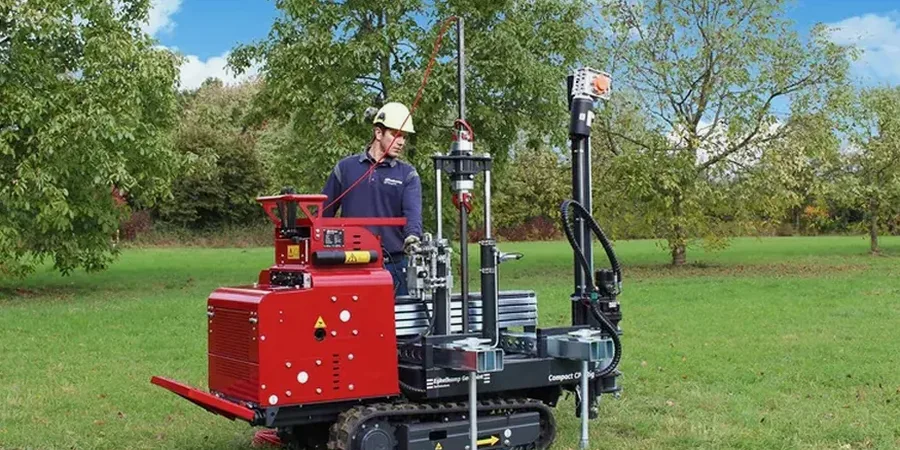
Fayetteville's growth from a frontier settlement on the Springfield Plateau into a dynamic economic hub has pushed development onto its complex residual soils and weathered shale. This isn't the Mississippi Delta. The chert-laden clays and solution-weathered limestone beneath this city can change bearing capacity within meters, a direct legacy of the Boone Formation geology. A standard drill rig often can't capture these thin, critical seams. That's why we deploy the Cone Penetration Test across Fayetteville projects. CPT provides a continuous, high-resolution profile of tip resistance and sleeve friction, mapping the erratic bedrock surface and detecting the soft zones that plague foundations near the West Fork White River. It's the fastest way to get reliable stratigraphy without fighting the chert float.
A continuous CPT profile in Fayetteville's karst can reveal a 2-inch clay seam at 20 feet that a split-spoon sampler would miss entirely.
Scope of work in Fayetteville Arkansas
Critical ground factors in Fayetteville Arkansas
A 5-story mixed-use foundation on Dickson Street was redesigned after standard borings missed a 3-foot layer of soft, compressible clay infill within a paleosink. The initial pad footing design would have settled differentially by over 2 inches. Our seismic CPT, measuring Vs shear wave velocity, identified the low-velocity anomaly immediately. The structural engineer switched to a deep foundation system bearing on competent limestone below the sinkhole throat. In Fayetteville's Springfield Plateau, subsurface erosion is ongoing. Ignoring the continuous stratigraphy that only a cone penetrometer can provide isn't just a technical oversight—it's a financial liability that can stop a project during excavation.
Our services
Our Fayetteville CPT program integrates field testing with advanced interpretation to de-risk your foundation design. We tailor each test to the local Boone Formation geology.
Piezocone Penetration (CPTu)
Records qc, fs, and u2 pore pressure at 1 cm intervals. Ideal for identifying thin drainage layers in the alluvial terraces near the White River.
Seismic CPT (SCPT)
Measures shear wave velocity (Vs) downhole at 1-meter intervals. Used to determine site class (C or D) per IBC for Fayetteville's stiff clays and weathered rock.
Dissipation & Equilibrium Tests
Monitors pore pressure decay after penetration stoppage. Provides coefficient of consolidation (cv) for settlement analysis in normally consolidated silts.
Common questions
What does a CPT test cost for a typical Fayetteville residential lot?
Can CPT replace all my soil borings in Fayetteville?
Not entirely. CPT provides continuous data but cannot retrieve physical samples. In Fayetteville's karst, we recommend pairing CPT with strategic mud rotary borings to confirm the limestone rock quality and weathering grade, especially in known sinkhole zones.
How do you classify soil from CPT data without a physical sample?
We use the Soil Behavior Type (SBT) classification system developed by Robertson. It combines corrected cone resistance (qt) and friction ratio (Rf) to distinguish between silty clays, sands, and sensitive soils. In the Boone Formation residuum, the SBT charts reliably differentiate between stiff clays and weathered limestone, a critical distinction for bearing capacity calculations.