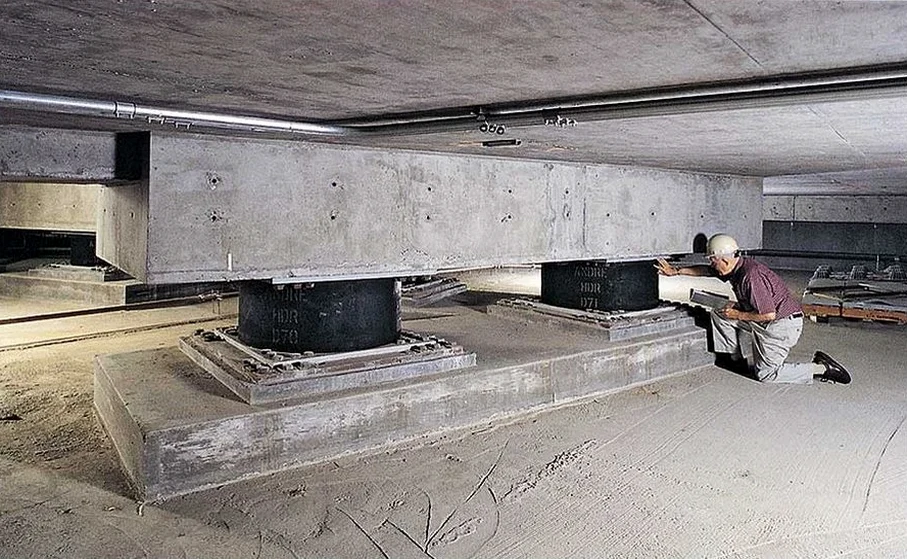
Many firms in Northwest Arkansas misjudge the seismic hazard. They assume the New Madrid Seismic Zone is the only threat. Fayetteville sits on complex geology that amplifies ground motion in unexpected ways. A standard fixed-base design transfers all that energy straight into the structure. Base isolation changes the equation. The building is decoupled from the ground with flexible bearings. Acceleration drops sharply. Drift is controlled. Contents stay in place. It is not just for hospitals and data centers anymore. Office buildings and retrofits benefit too. A seismic microzonation study refines the site-specific spectra before we select isolator properties. This avoids overdesign and keeps the isolation system cost-effective for Fayetteville conditions. We see too many projects where the isolation plane is detailed without considering local soil-structure interaction. That oversight leads to performance gaps the code does not forgive.
A properly tuned isolation system in Fayetteville can reduce base shear by 60 to 80 percent compared to a fixed-base design.
Scope of work in Fayetteville Arkansas
Critical ground factors in Fayetteville Arkansas
Fayetteville's population has grown past 95,000, and with it, the building inventory has expanded into areas with deeper soil deposits. The 1812 New Madrid earthquake, estimated at magnitude 7.5, caused ground failure as far west as the Arkansas River Valley. While that recurrence interval is long, the USGS hazard maps show a 5 to 10 percent probability of exceeding moderate shaking in 50 years for this region. A fixed-base building in downtown Fayetteville would experience floor accelerations that damage mechanical equipment and glazing. Base isolation cuts those accelerations to a fraction. The biggest risk is doing nothing. The second biggest risk is a poorly executed isolation design where the moat cover fails or the utility connections seize. We design the entire isolation plane as a system, not just a bearing layout, so the building moves freely when the ground shakes.
Our services
Our isolation design process is structured around the specific geology and seismic demand of Northwest Arkansas. Each phase delivers a clear deliverable.
Nonlinear Time-History Analysis
We develop a site-specific isolation model in ETABS or SAP2000. Ground motions are spectrally matched to the Fayetteville site class. The analysis includes upper-bound and lower-bound bearing properties, MCE displacement, and stability checks.
Isolator Specification & Peer Review Support
We prepare performance specifications for lead-rubber, high-damping rubber, or friction pendulum bearings. The package includes prototype test requirements per ASCE 7 Section 17.8 and support through the peer review process.
Common questions
What is the cost range for a base isolation seismic design in Fayetteville?
The engineering fee for a full isolation design, including nonlinear time-history analysis and specifications, typically ranges from US$4,200 to US$9,550 depending on the building complexity and number of ground motion pairs required.
Does the IBC require base isolation for certain Fayetteville buildings?
The IBC does not mandate isolation by occupancy alone. However, for Risk Category IV structures like hospitals, isolation is often the most cost-effective way to meet the stringent performance objectives. The decision is driven by a cost-benefit analysis of reduced damage versus the isolation system cost.
What site investigation data is needed before starting the isolation design?
A complete geotechnical report with site class determination per ASCE 7 Chapter 20 is essential. We need shear wave velocity data from MASW or downhole testing, plus stratigraphy from CPT or SPT borings to identify any soft clay layers that could amplify long-period motion.