One of the most expensive mistakes we see in Northwest Arkansas is assuming that all soil improvement methods work uniformly across the region. Fayetteville sits on the Springfield Plateau, where deeply weathered residual clays and silts derived from limestone and shale overlie pinnacled bedrock. These soils create a tricky profile: loose to medium-dense near the surface, with highly variable stiffness at depth. A vibrocompaction design that works in the alluvial plains of eastern Arkansas will fail here if it ignores the local stratigraphy. Before a single vibroflot enters the ground, the design needs to answer critical questions about maximum particle size, fines content, and the depth to competent bearing strata. We routinely pair our CPT testing with pre-densification sampling to map the transition from residual soil to weathered rock, which dictates the vibrator frequency and spacing grid. For sites near the West Fork or White River tributaries, the presence of alluvial lenses demands a hybrid approach, often combining vibrocompaction with stone columns to bridge soft pockets.
A vibrocompaction design calibrated to residual soils and karst margins transforms unpredictably loose ground into a uniformly dense formation ready for shallow footings.
Scope of work in Fayetteville Arkansas
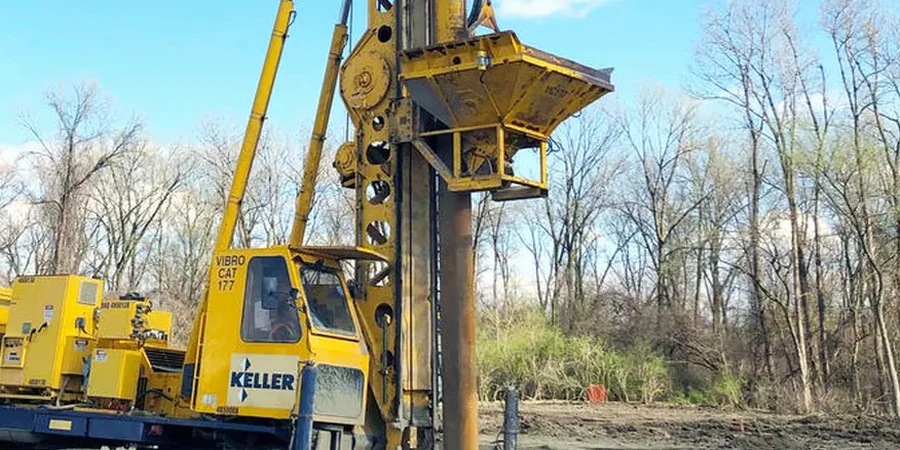
Critical ground factors in Fayetteville Arkansas
We reviewed a commercial project on Joyce Boulevard where the contractor proceeded with vibrocompaction based on an office-desk design that never checked the actual silt percentage. The site's residual soil ran 22 percent fines in the upper 12 feet, far above the standard threshold for effective densification. After three weeks of work, the post-treatment CPTs showed less than a 10 percent improvement in tip resistance, and the building pad was still too loose for the planned mat foundation. The owner lost six figures in schedule delays and had to pay for a stone column retrofit. That failure had nothing to do with the equipment or the operator: it was a design flaw. In Fayetteville's transitional geology, where the soil can change from a clean sand to a micaceous silt over 50 horizontal feet, the vibrocompaction design must be developed from adequate site investigation data, not regional assumptions. We also evaluate pore pressure dissipation during vibration, because if the silt matrix traps excess pressure, the soil mass simply does not densify.
Our services
Our vibrocompaction design package is built around the specific demands of Northwest Arkansas geology, from the Springfield Plateau to the deeper alluvial valleys. Each design includes a trial program, acceptance criteria, and a quality control plan that the specialty contractor can execute directly.
Performance-Based Vibrocompaction Design
We develop a site-specific densification specification that defines target relative density, vibrator energy input, grid geometry, and backfill gradation. The design is calibrated to Fayetteville's residual soil profiles and includes settlement and bearing capacity verification after improvement.
Pre-Design Site Characterization for Vibro Systems
Using CPT soundings, SPT borings, and laboratory index testing, we map the vertical and lateral variability in fines content and density. This data drives the decision between pure vibrocompaction, vibro-replacement, or a hybrid approach with stone columns.
Post-Treatment Verification and QC Testing
We execute an independent QA program using pre- and post-densification CPT pairs, nuclear density gauge testing in shallow lifts, and MASW shear-wave velocity profiles to confirm that the improved ground meets the design specification and IBC acceptance criteria.
Common questions
What factors determine whether a site in Fayetteville is suitable for vibrocompaction?
The primary factor is fines content. In Fayetteville's residual soils, we look for less than 15 percent passing the No. 200 sieve for pure vibrocompaction. Above that threshold, the silt and clay begin to dampen the vibratory energy, and we evaluate a hybrid approach. Depth to rockhead is the second key factor: if competent limestone is within 10 to 15 feet, the vibrator may not achieve proper resonance. We also check groundwater depth, because a high water table aids the densification process by reducing interparticle friction.
How long does a typical vibrocompaction design and verification process take in Northwest Arkansas?
The design phase, including site characterization and trial zone testing, typically spans three to four weeks. The trial zone itself is completed in one to two days, but we allow time for pore pressure dissipation before running post-treatment CPTs. Full production densification for a two-acre commercial lot in Fayetteville usually takes five to seven working days with one rig, followed by a verification program of three to five days. Weather delays from spring thunderstorms can stretch the schedule, so we recommend building in a week of contingency from March through May.
What is the typical cost range for a vibrocompaction design package in Fayetteville?
Can vibrocompaction improve the seismic site class on a Fayetteville project?
Yes, and this is a significant value driver for projects in Fayetteville's moderate seismic hazard zone. By densifying loose sands and silty sands, we can often raise the average shear-wave velocity in the upper 100 feet enough to move the site from a default Site Class D to a Site Class C per ASCE 7-22 Table 20.3-1. This reclassification reduces the design spectral accelerations and can lower the structural cost for the superstructure. We confirm the upgraded site class with post-treatment MASW testing.