We've seen it too many times in Fayetteville. A foundation crew hits weathered shale at 4 feet when the logs said stiff clay. The excavator stalls. The schedule slips two weeks. That's what happens when the soil mechanics study skips lab verification. Fayetteville sits on the Springfield Plateau. Residual soils here derive from Mississippian limestone and shale. Weathering is uneven. You can't rely on visual classification alone. Our team runs Atterberg limits, triaxial shear, and consolidation tests on every sample. We correlate field SPT data with lab-measured strength. The result is a bearing capacity number you can stake your permit on. For deep excavations in downtown Fayetteville near Dickson Street, we often combine lab data with slope stability analysis to protect adjacent historic structures.
Lab-measured residual soil strength in Fayetteville often drops 30% from dry to saturated conditions — a number that changes foundation dimensions.
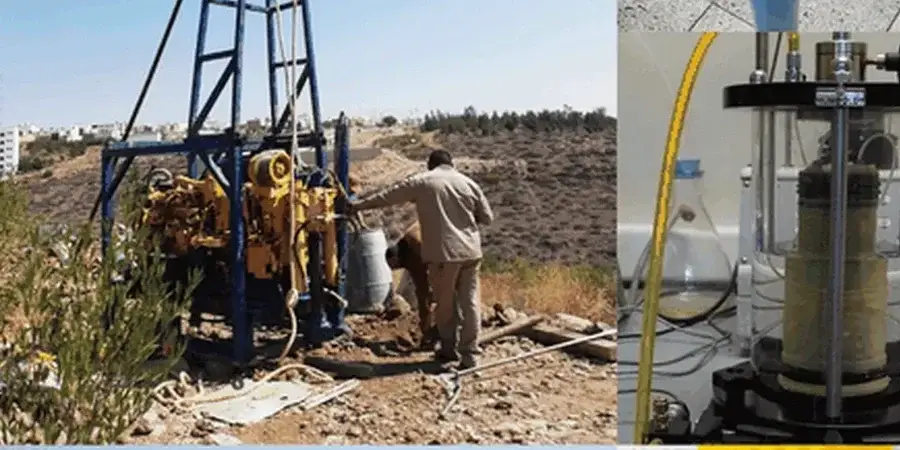
Scope of work in Fayetteville Arkansas
Critical ground factors in Fayetteville Arkansas
A six-story mixed-use building on College Avenue. Geotech report from a desktop study said "stiff clay, 3 ksf bearing." Footings went in. Three months later, differential settlement cracked the stairwell drywall. The real profile: 5 feet of undocumented fill over a wet-weather spring zone. Lab tests on our Shelby tube samples showed the fill had 40% fines and collapsed at 2.1 ksf. The soil mechanics study we performed afterward included triaxial CU tests and consolidation curves. Fayetteville's karst geology hides voids, soft seams, and perched water. Lab testing isn't a box to check. It's the cheapest insurance policy on the job site.
Our services
We deliver a soil mechanics study that answers the three questions every Fayetteville contractor asks: What's the bearing pressure? How much will it settle? Will it change when it rains?
Complete Lab Testing Program
Moisture content, Atterberg limits, grain-size distribution, Proctor compaction, direct shear, triaxial CU, and one-dimensional consolidation. All testing follows ASTM standards with a signed report from our engineer. Turnaround in 7 business days for standard suites.
Field-to-Lab Correlation Report
We pair your SPT or CPT field data with our lab results. Bearing capacity calculations per Terzaghi and Meyerhof. Settlement predictions for square and strip footings. Modulus of subgrade reaction for slab design.
Common questions
What does a soil mechanics study cost for a typical Fayetteville residential lot?
How long does the lab testing take after samples arrive?
Standard lab suites (classification, shear, consolidation) take 7 business days. Expedited service is available for an additional fee. Time-sensitive tests like moisture content can be reported within 24 hours.
Do I need a soil mechanics study for a retaining wall under 4 feet in Fayetteville?
IBC exempts walls under 4 feet from engineered design, but Fayetteville's expansive residual clays can still cause problems. We recommend at minimum a classification suite to check the PI. It's a small cost compared to wall replacement.
Can you test for collapsible soils common in Northwest Arkansas?
Yes. We run consolidation tests on undisturbed samples at natural moisture content and again after saturation. The collapse potential is calculated per ASTM D5333. Many Fayetteville fills show moderate to severe collapse potential when wetted.