The hydraulic excavator bucket scrapes through the red clay crust and hits weathered shale at four feet—right where the footing bearing elevation was planned. That is the typical opening scene for a shallow foundation design project in Fayetteville. The contact between the residual St. Joe limestone-derived clays and the underlying Boone Formation shale creates a bearing stratum that can shift from stiff to soft within a single lot. We run the design process starting with ASTM D1586 spt-drilling borings to measure N-values at the proposed footing depth, followed by lab classification per ASTM D2487 on samples recovered from each change in stratum. For wider footprints where differential settlement across the clay-shale transition is a concern, we often pair the investigation with mat foundations analysis to evaluate whether a rigid mat can bridge the variable compressibility without exceeding the IBC total settlement limit of one inch. The goal is always the same: a bearing pressure recommendation that works with the Boone Formation geology, not against it.
In Fayetteville, the difference between a 2,500 psf footing and a 4,000 psf footing is often just eighteen inches of excavation—knowing exactly where to stop is what the investigation delivers.
Scope of work in Fayetteville Arkansas
Live process video
Critical ground factors in Fayetteville Arkansas
The Boone Formation shale that underlies much of Fayetteville is a notorious moisture-sensitive material. When exposed during excavation, it can slake within hours if left uncovered before the mudmat is poured. More critically, the contact between residual clay and weathered shale acts as a perched water trap during the wet spring months—March through May bring an average of five inches of rain per month to Washington County, and that water moves laterally along the clay-shale interface, softening the bearing stratum directly beneath the footing. The IBC requires that footings bear on undisturbed native soil or adequately compacted engineered fill; softening from perched water invalidates the undisturbed assumption. Our design approach includes a mandatory subdrain detail for any footing that will intercept the weathered shale within three feet of design grade, and we specify a minimum 24-hour window between final subgrade inspection and concrete placement to verify that no softening has occurred. The seismic demand in Fayetteville is moderate—ASCE 7 places the city in a region with Ss values around 0.25g—but the site class amplification on soft clay can push the design spectral acceleration higher, which directly impacts the footing size required to resist overturning.
Our services
Each shallow foundation design we deliver for Fayetteville projects includes the full chain of investigation, analysis, and documentation required for building permit approval.
Bearing capacity and settlement analysis
We calculate net allowable bearing pressure using the general shear failure equation with Vesic bearing capacity factors, corrected SPT N60 values, and consolidation settlement estimates from one-dimensional lab tests on undisturbed Shelby tube samples. Every report includes the factor of safety against bearing failure (minimum 3.0 per IBC) and the predicted total and differential settlement.
Footing subgrade inspection and verification
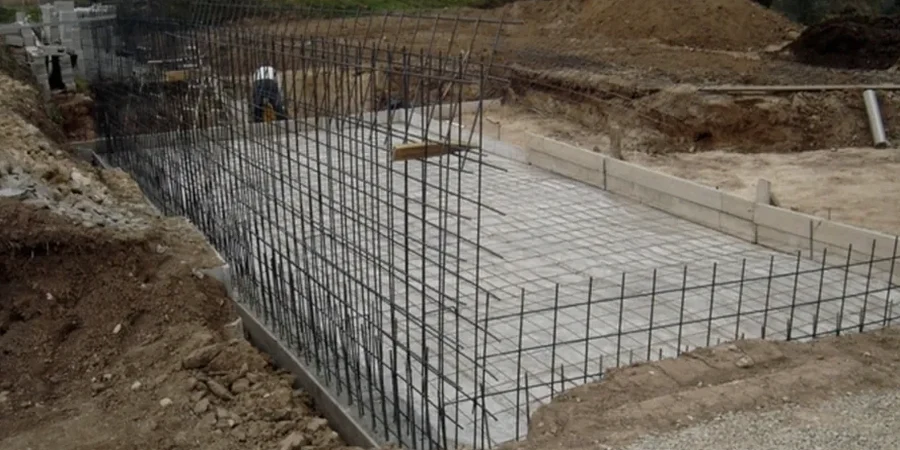
Before the rebar cage is placed, our engineer visits the excavation to confirm that the bearing material matches the geotechnical report assumptions. We use a hand penetrometer and visual classification to verify consistency, check for perched water or slaking shale, and document the condition with photographs and a signed inspection report for the city building department.
Alternative foundation comparison reports
When the shallow bearing stratum is marginal—say, N60 values below 8 in the upper five feet—we prepare a comparative analysis weighing the cost of over-excavation and engineered fill against a footings design on deeper compacted lifts or a transition to a stiffened mat. The comparison includes concrete quantities, excavation volumes, and schedule impact so the structural engineer and contractor can make an informed decision.
Common questions
What is the typical allowable bearing pressure for a residential footing in Fayetteville?
In the western part of the city on stiff residual clay, we commonly recommend 3,000 to 3,500 psf. East of College Avenue, where colluvium and weathered shale are more prevalent, the numbers drop to 2,000 to 2,500 psf. Every site needs its own borings—the Boone Formation contact depth varies enough that two adjacent lots can have different bearing recommendations.
How much does a shallow foundation design and soil investigation cost for a single-family home?
Do I need to worry about expansive soils for my footing design in Fayetteville?
It depends on the neighborhood. The residual clays derived from the St. Joe limestone generally have plasticity indices below 15 percent, which puts them in the low expansion range. But where the Boone shale has weathered to a fat clay, PI values can exceed 25 percent. We test every sample for Atterberg limits and flag any layer with PI above 15 so the structural engineer can specify the appropriate reinforcement and underslab details.
What is the minimum footing depth required by code in Fayetteville?
The IBC requires footings to bear below the frost depth, which for Northwest Arkansas is 18 inches. However, the real driver in Fayetteville is not frost—it is reaching undisturbed native soil below the topsoil and any fill. In practice, we almost always specify 30 to 36 inches of embedment to get past the organic layer and into competent residual clay or weathered rock. The city building department expects to see the geotechnical report confirming that the bearing stratum meets the design assumptions before they sign off on the footing inspection.